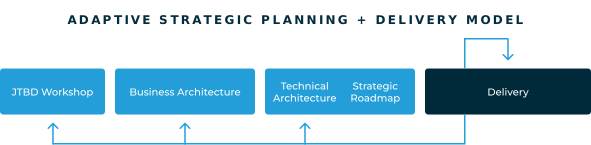
Delivering Seamless Intelligent Experiences:
Synchronizing JTBD with Strategic Architecture Enables an Adaptive Delivery Model
The iterative use of this architecture framework begins with the correlation of the business strategy (Goals, Objectives and Priorities), with the key Jobs to Be Done, Job Performer Journeys, and primary Business, Foundational, Data and AI/Agentic capabilities. A rapid digital design and prototyping exercise at this point visualizes what a possible digital experience can achieve and prioritize what can be built.
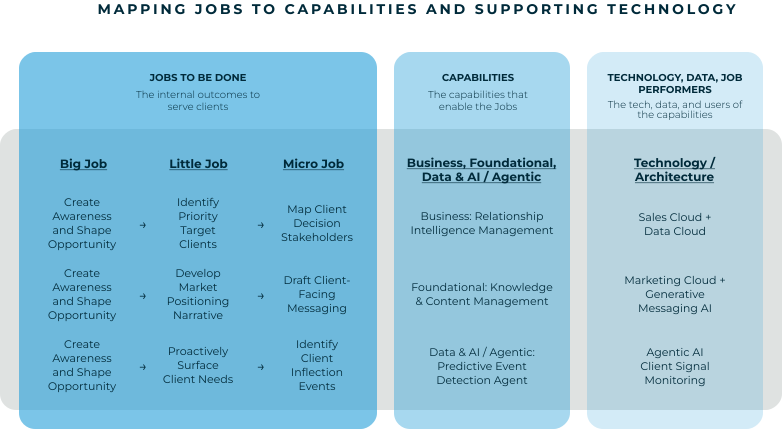
With that, we dive into the data, technology and architecture that is needed to enable the experience (for both current and future needs). Figure E shows a conceptual model view of how the Jobs to Be Done are mapped to their corresponding business, foundational, data capabilities, and AI/Agentic capabilities, as well as how those correspond to the technical architecture and supporting technology.
It may actually be that there is little to no correlation with a business need for either business capabilities and/or technical solutions. That’s fine since it points out missing capabilities and missing technologies. We often find that the technology solution is only partially enabling what the business needs or that there are redundant, incomplete or broken solutions to a single capability. As this mapping assessment continues, a clearer picture begins to emerge of the future architecture needed to enable the business needs.
Figure E
Conceptual model of how the Jobs to Be Done relate to corresponding capabilities and technical architecture.
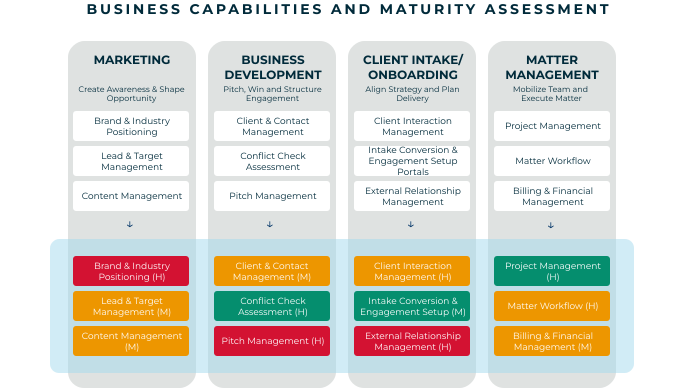
A formal analysis of all of your business, foundational and data capabilities that have been identified must be done with input from the business and technical groups of your company. This is called a capabilities maturity assessment and it yields a diagnostic of strengths and weaknesses of the existing (and additional) capabilities across all business domains. We use a simple Red=Missing or Broken, Yellow=Incomplete or Marginal, and Green=Meets or Exceeds needs assessment as shown in Figure F. You will then finish this portion by assessing the Foundational, Data, and AI/Agentic capabilities identified in this step.
A key residual result of this approach is the tight alignment between Business Strategy, Jobs to Be Done and the Strategic Roadmap that drives the overall enterprise architecture. If something in the technical architecture doesn’t correspond to what the business needs, then it is likely not needed or placed lower in priority to address.
The next step in the methodology is to capture, organize, and detail the current state architecture. We visualize the business domain value streams (marketing, sales, service, etc., from left to right) coupled with the “Big” Jobs to Be Done to set the business domain and user context. This makes the architecture easy to understand by the business and shows what technology is used in the course of business.
Figure F
Mapping capabilities by value stream and corresponding Jobs to Be Done.
A corresponding maturity assessment and diagnostic (lower portion) assesses the business value (High / Med / Low), and creates a visual heat map of strengths and gaps (Red / Yellow / Green) in current or missing capabilities.
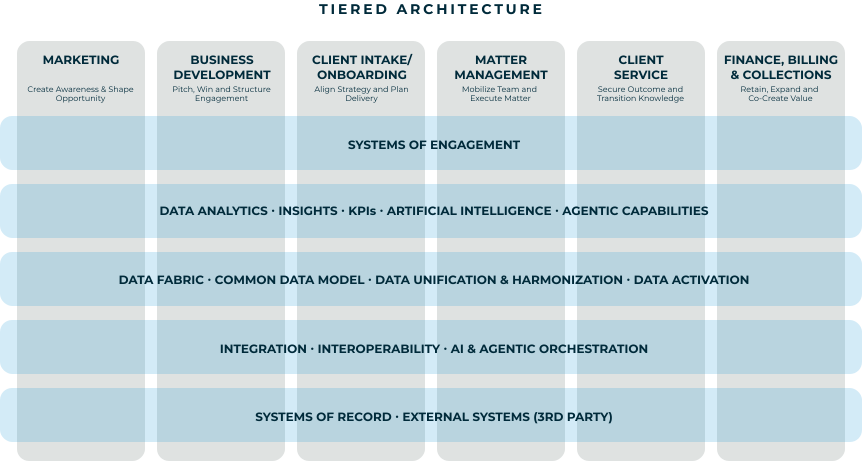
We will vertically arrange the technology into primary architecture tiers such as:
Systems of Engagement tier that shows systems like Marketing Automation, Customer Relationship Management (CRM), External Relationship Management (ERM), Service/Support solutions, etc.
Data Analytics/Insights/KPIs, AI and Assistive/Autonomous Agents tier that delivers enterprise and domain analytics, key insights, KPIs, and both AI and Agentic capabilities.
Data Fabric/Unified Data Tier represents common language, unified and harmonized data capabilities founded on a canonical data model and sources from any cloud or legacy data source. This is a key provider of data for things like Customer 360, Predictive AI, Generative AI, Agentic use cases and Data Quality curation. We also drive out the Semantic/Contextual metadata/data model that provides the needed context your AI and Agentic reasoning engine to achieve the highest, most reliable response. For example, in financial services this would include risk and regulatory ontologies; in healthcare, clinical terminology standards (HL7 FHIR, SNOMED); in manufacturing, product and supply chain taxonomies. Each industry brings its own domain-specific semantic models that must be curated alongside your organization’s proprietary data representations.
Integration/Interoperability tier that indicates what and how you integrate your data and applications with. This should also be fully embracing a common data language that corresponds to the unified data layer allowing rapid, consistent integration with both internal and external systems.
System of Records (SOR) tier that shows the primary core systems for things like ERP, HR, Billing, and other core SOR’s.
You will develop a first draft of a future state architecture that meets current and future needs (Figure G) based on the Business Strategy, the Jobs to Be Done, the capabilities needed and their maturity, and the Current State Architecture. This is also your opportunity to rationalize out redundant systems, consolidate platforms, and do critical Data, AI, and Agentic readiness discovery.
Figure G
Technology can be arranged into primary architecture tiers while keeping the context of the business domains and the Jobs to Be Done.
This future state becomes your “north star” and is highly aligned to the business strategy of the company. Your future state architecture must also follow industry leading architecture principles and perhaps also embrace your digital first product or service platform model if that is a path you are using. At a minimum, you should fully understand commodity versus your competitive advantage solutions and focus your development teams on what your secret sauce is (and not on what you can get out of the box from your providers).
You also have the early AI and Agentic opportunities clearly identified from the JTBD mapping that can now be used to drive the appropriate AI or Agentic capability where it is needed and that will yield the highest value. Figure G.2 shows a quick glimpse of how to correlate the JTBD job to an Agentic capability, leveraging the clear and concise job and the point in the “flow of work” to define exactly where and what the Agent should do.
Figure G.2
How Jobs to Be Done provide the context and correlation for agentic capability design, mapping each job to the precise point in the flow of work where an agent should act, what it should do, and why.
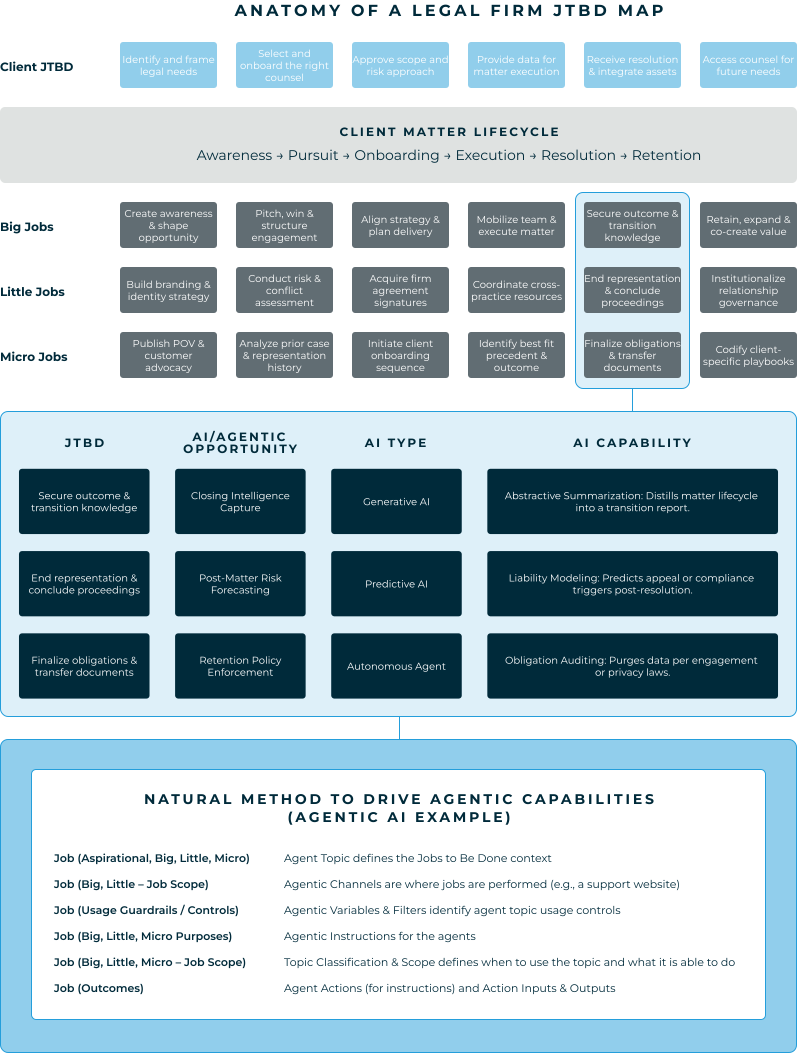
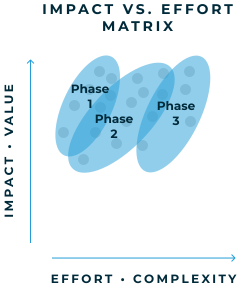
Figure H
The value vs. complexity analysis helps you prioritize the strategic roadmap.
Once completed and vetted with your organization, you must thoroughly assess the business value, priority, alignment with business strategy and the technical complexity of the things added in the future state vision as shown in Figure H.
The Business impact versus Technology complexity and effort analysis identifies what must be done first (Foundation Phase), second (Optimize Phase), and third (Expand Phase). This becomes your strategic roadmap (see Figure I) with a 1 to 3 year horizon that will evolve as you iterate through the strategic architecture framework.
The Intelligent Experience Architecture™ framework illustrates the Strategy-to-Delivery Value Loop (Figure I.2). Three architecture layers, experience, business, and technical, build on each other and stay traceable to executive priorities and customer outcomes, culminating in a phased strategic roadmap for execution. The loop is continuous: delivery performance data refines strategy, surfaces new priorities, and accelerates decision velocity, ensuring the architecture evolves with the organization.
Figure I
Strategic roadmap becomes your 1-3 year horizon to focus solution delivery.
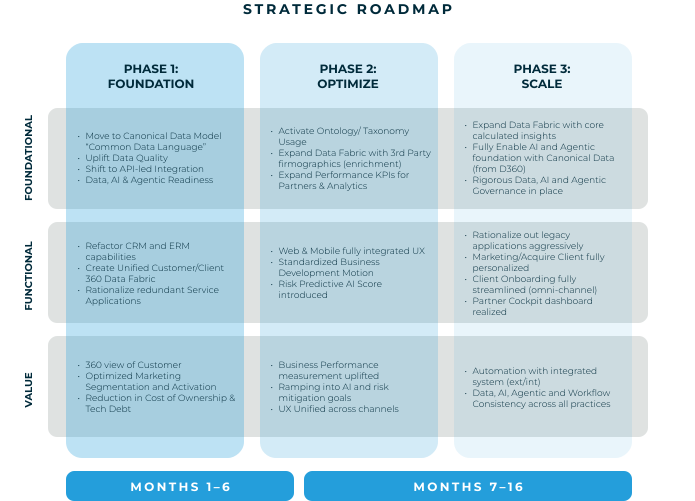
Figure I.2
The Strategy-to-Delivery Value Loop, illustrating how experience, business, and technical architecture layers connect and sustain alignment between executive priorities and delivery outcomes through a continuous feedback cycle.